

You can know plenty of Dutch grammar and vocabulary and still sound a little “too textbook”. In everyday conversations, Dutch people use lots of small words and expressions that add feeling, emphasis or nuance.
Here are a few expressions you will often hear in spoken Dutch.
1. Hèhè!
Hèhè! is something Dutch people say when something is finally finished or when you can finally relax. It’s usually accompanied by a sigh of relief.
For example:
Imagine you’ve been putting together an IKEA wardrobe for two hours. You put the last screw in, step back and look at your work.
Hèhè!
It expresses a feeling of relief or satisfaction.
You can also use it when something you’ve been waiting for finally happens:
Hèhè, de kinderen liggen eindelijk in bed.
Phew, the kids are finally in bed.
The exact English translation depends on the situation, but the feeling is usually the same: “Finally!” or “What a relief!”
2. Zeg maar
Zeg maar is extremely common in spoken Dutch. People use it when they are thinking, looking for the right word or explaining something. Depending on the context, it can often be translated as “like” or “sort of” in English.
For example:
Mijn broer is zeg maar een soort expert op het gebied van computers.
My brother is, like, an expert when it comes to computers.
It can also be used when you’re trying to explain something in a simple way:
Een dijk is zeg maar een soort muur die het water tegenhoudt.
A dike is sort of like a wall that keeps the water out.
You will hear zeg maar a lot in informal conversations. Dutch speakers sometimes use it automatically without even noticing.
Tip: You don’t need to use zeg maar in every sentence. A little goes a long way, zeg maar.
3. Hoor
For English speakers, ‘hoor’ can sound a little strange at first because it sounds very similar to a certain English word! 😄 Don’t worry — in Dutch, ‘hoor’ is completely innocent and is simply used to add a little extra feeling to a sentence.
Hoor is often placed at the end of a sentence. It doesn’t have one exact English translation. Instead, it adds a certain tone to what you’re saying.
For example:
Je hoeft echt niet op me te wachten, hoor.
You really don’t have to wait for me, you know.
Here, hoor makes the sentence sound friendly and reassuring.
You can also use it to emphasise something:
Dat was helemaal niet makkelijk, hoor.
That really wasn’t easy, you know.
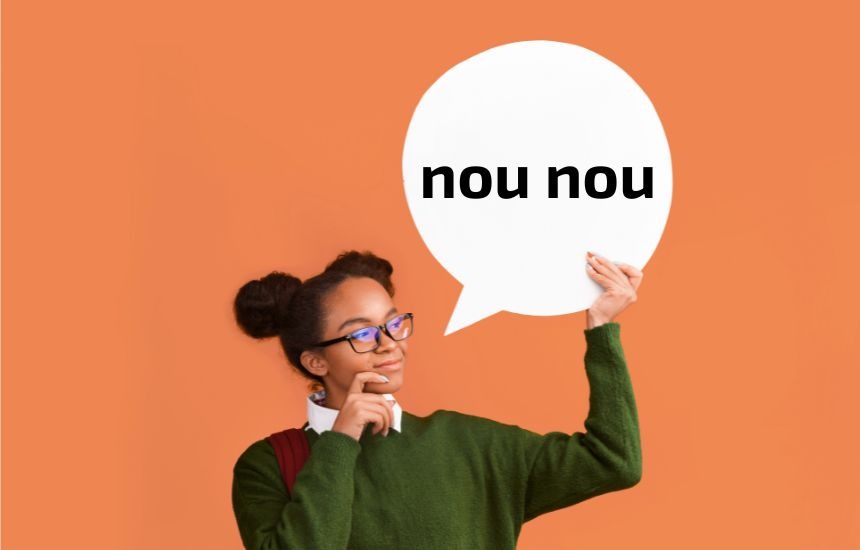
4. Nou nou...
Nou nou can be used when you’re surprised, impressed or think someone is exaggerating.
Imagine your friend tells you:
Ik heb dit weekend duizend euro uitgegeven aan een horloge.
I spent a thousand euros on a watch this weekend.
You might respond:
Nou nou…
Depending on your tone, you could mean Well, well… or something like Wow, that’s quite something!
It can also be used when someone is being a little dramatic:
Ik kan echt nooit iets goed doen!
I can never do anything right!
Nou nou, rustig maar.
Oh, come on, calm down.
So listen carefully to the intonation. Nou nou can sound sympathetic, surprised, amused or slightly disapproving.
5. Toch
Toch is one of the most useful little words in Dutch — and one of the hardest to translate with just one English word.
One common use is to check something you expect to be true:
We eten vanavond bij jou thuis, toch?
We’re having dinner at your place tonight, right?
But toch can also express a contrast:
Ik was eigenlijk te moe om te gaan, maar ik ben toch gegaan.
I was actually too tired to go, but I went anyway.
And sometimes it can be used to encourage someone:
Probeer het toch gewoon!
Just give it a try!
So don’t try to memorise one translation for toch. Look at the context and listen to the speaker’s tone.
6. Joh
Joh is very informal and is mainly used with friends, family and people you know well.
It can express encouragement, surprise, reassurance or mild annoyance.
For example:
Joh, maak je daar niet druk om.
Hey, don’t worry about it.
Or:
Dat meen je niet, joh!
No way! / You can’t be serious!
You can also use it to encourage someone:
Kom op, joh. Je kunt het!
Come on. You can do it!
You may also hear hé joh when someone wants to get another person’s attention:
Hé joh, je bent je telefoon vergeten!
Hey, you forgot your phone!
Because joh is very informal, it’s best saved for casual conversations rather than formal situations.

Listen for the little words
These expressions might seem small, but they are an important part of spoken Dutch.
Start by listening for them in conversations, TV shows and podcasts. Once you recognise them, try using one or two yourself.
You don’t need to use them all at once. A few well-placed Dutch expressions can make your Dutch sound much more natural.
Want to learn more everyday Dutch? Check out our Dutch courses.